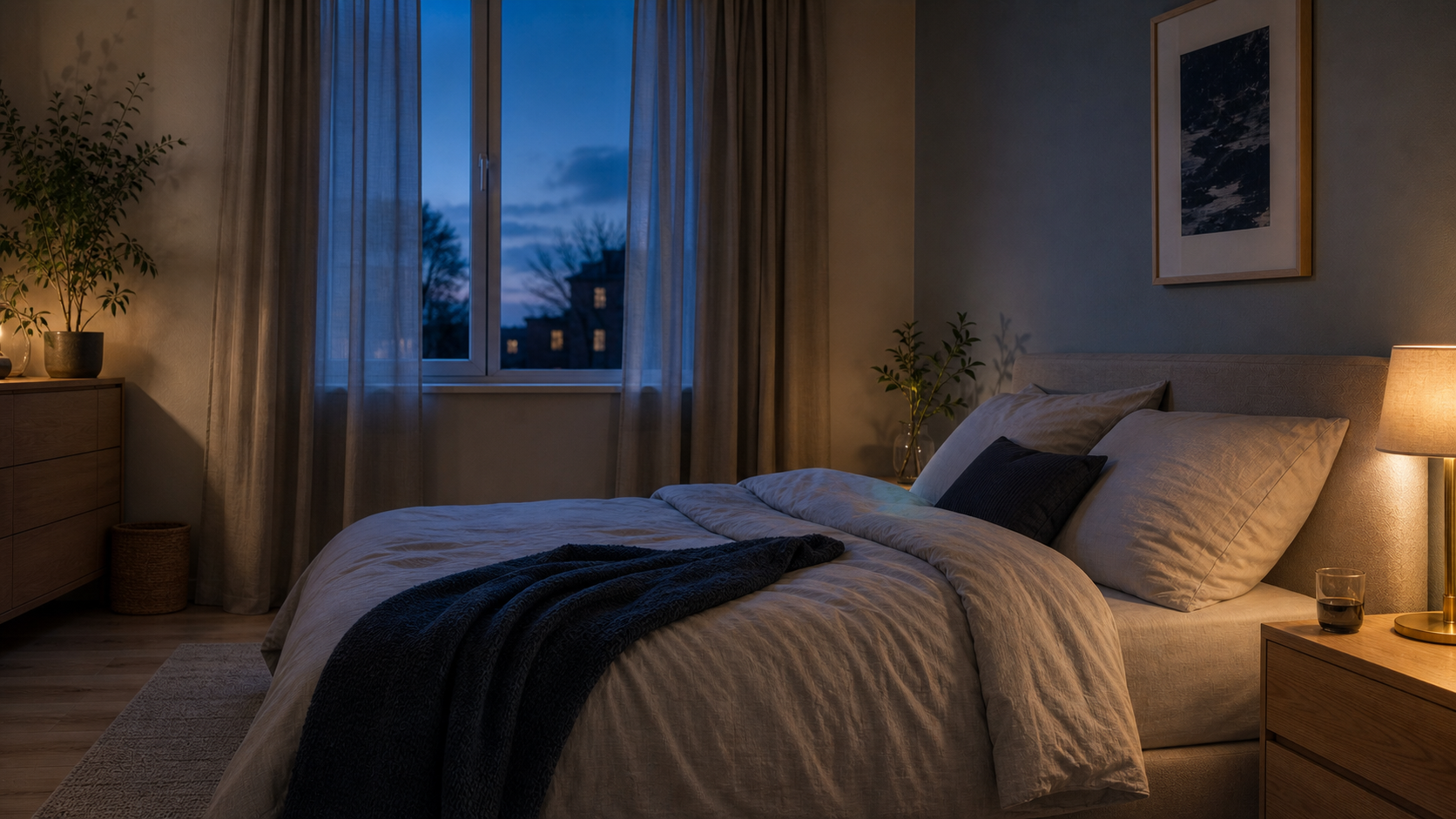
A sleep-friendly bedroom cannot make sleep happen on command. It can, however, remove avoidable friction. If street light reaches your pillow, traffic wakes you, bedding traps heat, or your body never quite settles, those are practical problems worth addressing.
The aim is not a showroom-perfect “sleep sanctuary.” It is a room that feels safe, usable and comfortable enough for your body and routine. NHS and CDC guidance consistently points to darkness, less disruptive noise, a comfortably cool room and comfortable bedding, while also leaving room for personal preference.1, 2, 6
Start with the thing that actually gets in your way
Before buying anything, notice what happens in your own room for a few nights. This is not a sleep score and you do not need an app. You are simply looking for a practical pattern:
- Is there light on your face when you are trying to settle?
- Do sudden sounds wake you, or is the room uncomfortably silent?
- Do you wake feeling too warm, too cold or clammy?
- Does a pillow, mattress or heavy cover create pressure or make turning difficult?
- Do alerts, a visible clock or work items keep pulling your attention back to the day?
If keeping notes makes you more watchful or anxious, skip it. Choose the most obvious source of friction and test one small change. Several changes at once make it harder to tell what helped.
1. Shape light across the whole day
Light is not only something to block at bedtime. It is also an important timing signal for the body clock. A systematic review found that the relationship between light and sleep depends on timing: brighter morning light was generally associated with earlier sleep timing, while brighter evening light was associated with later timing and worse self-reported sleep.3
That does not mean every lamp or screen is a sleep emergency. A calmer approach is to create contrast: useful daylight after waking when you can get it, gentler light in the run-up to bed, and less unwanted light while you sleep.
Try the simplest light changes first
- Dim overhead lighting before bed if it feels stark or activating.
- Turn off, cover or turn away small LEDs that reach the bed.
- Put the phone face down, silence non-essential alerts and keep it out of reach if possible.
- Close curtains or blinds fully; address bright gaps before replacing the whole window treatment.
- If you share a room, travel, sleep during the day or cannot change the curtains, a comfortable option from our sleep mask collection may be the more flexible solution.
Darkness should never create a fall risk. Keep the route to the bathroom clear and use the lowest practical, shielded light if you need to move safely at night. For products intended to support deliberate light timing rather than darkness, see Light & Rhythm; check brightness, controls and intended use rather than assuming any lamp will change your sleep.
2. Reduce disruptive noise, not every sound
WHO guidance identifies environmental noise as a contributor to sleep disturbance, and research on road, rail and aircraft noise finds an association with self-reported sleep disturbance.4, 5 Your goal does not have to be complete silence. Notice whether a steady background or sudden changes—a door, a notification, a passing vehicle—are what disturb you; the answer is personal.
Work from source to listener
- Stop avoidable indoor sounds first: mute notifications, steady a rattling fan and move vibrating devices away from hard furniture.
- Close gaps around a door or window when that is where the sound enters. Soft furnishings may reduce echo, but they will not soundproof a room.
- Agree quiet periods with other people in the home where possible, especially for shift work or daytime sleep.
- Consider well-fitting earplugs only if you can still respond to alarms, children, care responsibilities or emergencies.
- If you choose to try a steady background sound, keep it at the lowest practical volume, place the source away from your head and stop if it feels distracting.
White noise, rainfall or a fan is an optional experiment, not a requirement or a treatment for insomnia. Evidence for steady background sound as a sleep intervention is mixed and generally low quality, and some people find it distracting.8 Judge it by your own comfort and safety rather than by a promise of better sleep.
3. Aim for thermal comfort, not a magic number
Public-health guidance commonly recommends a cool bedroom, but there is no single temperature that suits every adult, season, home or bedding setup.2, 6 What matters is whether you can settle without shivering, sweating or repeatedly changing covers.
Start with the easiest layer to adjust. Use bedding that can be added or removed without remaking the bed. If the room is stuffy, ventilate it when doing so is safe; a fan may help with air movement, although its sound will suit some people more than others. Think about the combined system—room temperature, sleepwear, duvet, mattress protector and whether you share the bed—rather than focusing on the thermostat alone.
Needs can change with weather, illness, medication, pain or menopause. New or persistent night sweats, fever or other concerning symptoms deserve medical advice rather than another cooling product.
4. Let comfort guide the bed setup
A mattress or pillow does not become “sleep healthy” because it is firm, soft, expensive or labelled orthopaedic. There is no universal pillow height or mattress feel. A useful setup supports your usual position without creating obvious pressure, strain, overheating or a fight with the bedding.
A practical comfort check
- Notice whether your head is pushed sharply up or drops uncomfortably back.
- Check for visible sagging, broken parts, bunching protectors or fitted sheets that pull the surface tight.
- Ask whether pressure at the shoulder or hip, partner movement, heat or restricted turning is the real issue.
- Test a different pillow height, cover weight or topper separately before replacing the whole bed.
- Judge change by comfort over several nights, not by a dramatic first impression.
If you are comparing options in Pillows & Bedding, look for verified dimensions, materials, care information and a clear return policy. A product description should help you decide who it may and may not suit; it should not promise to cure pain or guarantee deeper sleep.
5. Remove small cues to stay alert
Not every home can reserve a bedroom only for sleep. If yours is also an office, dressing room or family space, aim for a visible transition rather than a rigid rule. Close the laptop, put work papers in a box, turn the clock away and set out anything you regularly search for at night. A clear walking route matters more than decorative minimalism.
If you are awake and becoming frustrated, forcing sleep can add pressure. NHS guidance suggests moving to a comfortable place for a quiet activity and returning when you feel sleepier.1 Our articles on when sleep starts to feel frightening and waking at 3 a.m. explore that response without treating normal wakefulness as failure.
A low-pressure bedroom reset
You can make a useful first pass in ten minutes: silence non-essential alerts, block the most obvious light, choose a cover that fits the season, turn the clock away and clear the floor beside the bed. Then leave the room alone for the night.
Over the next week:
- Choose one recurring problem: light, sound, temperature or physical comfort.
- Make the smallest change that directly addresses it.
- Keep the change for a few nights unless it is clearly uncomfortable or unsafe.
- Notice whether the original problem became less intrusive.
- Keep what is useful and undo what is not. You do not have to optimise every detail.
This sequence protects you from buying a collection of “sleep solutions” when a curtain gap, notification setting or lighter cover was the real issue. If you do need a product, you can browse all sleep essentials by the obstacle they are designed to address.
What a better bedroom cannot do
Environmental changes can support comfort and reduce interruptions. They do not diagnose or treat a sleep disorder, and sleep-hygiene advice alone is not considered sufficient treatment for chronic insomnia. The American Academy of Sleep Medicine gives a strong recommendation for multicomponent cognitive behavioural therapy for insomnia (CBT-I) for adults with chronic insomnia.7
Talk with a qualified healthcare professional if sleep problems have lasted for months, make daily life hard to manage, or continue despite reasonable changes. Seek assessment for signs such as loud snoring with breathing pauses or gasping, severe daytime sleepiness, persistent uncomfortable sensations in the legs, or symptoms linked to pain, mood, medication or another condition. The room can be supportive while the underlying issue still needs proper care.
Frequently asked questions
What is the best bedroom temperature for sleep?
There is no universal number. A slightly cool room is a sensible starting point, then adjust the room, sleepwear and covers until you are comfortable rather than cold or overheated.
How dark should a bedroom be?
Reduce light that reaches your eyes or wakes you, but keep safety first. Blackout curtains, covering small LEDs or an eye mask are different ways to solve the same practical problem.
Are blackout curtains better than a sleep mask?
Neither is automatically better. Curtains work for the whole room; a mask is portable and may be easier in rented or shared spaces. Fit and comfort decide whether a mask is useful.
Does white noise help everyone sleep?
No. Some people find a steady sound makes traffic or household changes less noticeable; others find it distracting. Test it quietly and make sure you can still hear anything important.
How often should I replace my mattress or pillow?
A fixed marketing deadline is less useful than condition and comfort. Look for damage, persistent sagging, loss of shape, hygiene issues or a clear mismatch with your needs, and check the maker’s care and warranty information.
Can a sleep-friendly bedroom cure insomnia?
No. It may remove obstacles and support a routine, but persistent insomnia can have several causes and deserves evidence-based assessment and care.
Sources and further reading
- NHS: How to fall asleep faster and sleep better
- CDC: About Sleep
- Sleep Health: systematic review of light timing and sleep in adults
- World Health Organization: Guidance on environmental noise
- Environmental Health Perspectives: environmental noise and sleep meta-analysis
- NHS: Insomnia
- American Academy of Sleep Medicine: clinical practice guideline for chronic insomnia in adults
- Sleep Medicine Reviews: continuous noise as a sleep aid systematic review
This article is for general education. It is not medical advice and does not replace individual assessment.
Share:
Waking Up at 3 a.m.: Why It Happens and What Helps
When Sleep Feels Frightening: A Calm Guide to Sleep Anxiety