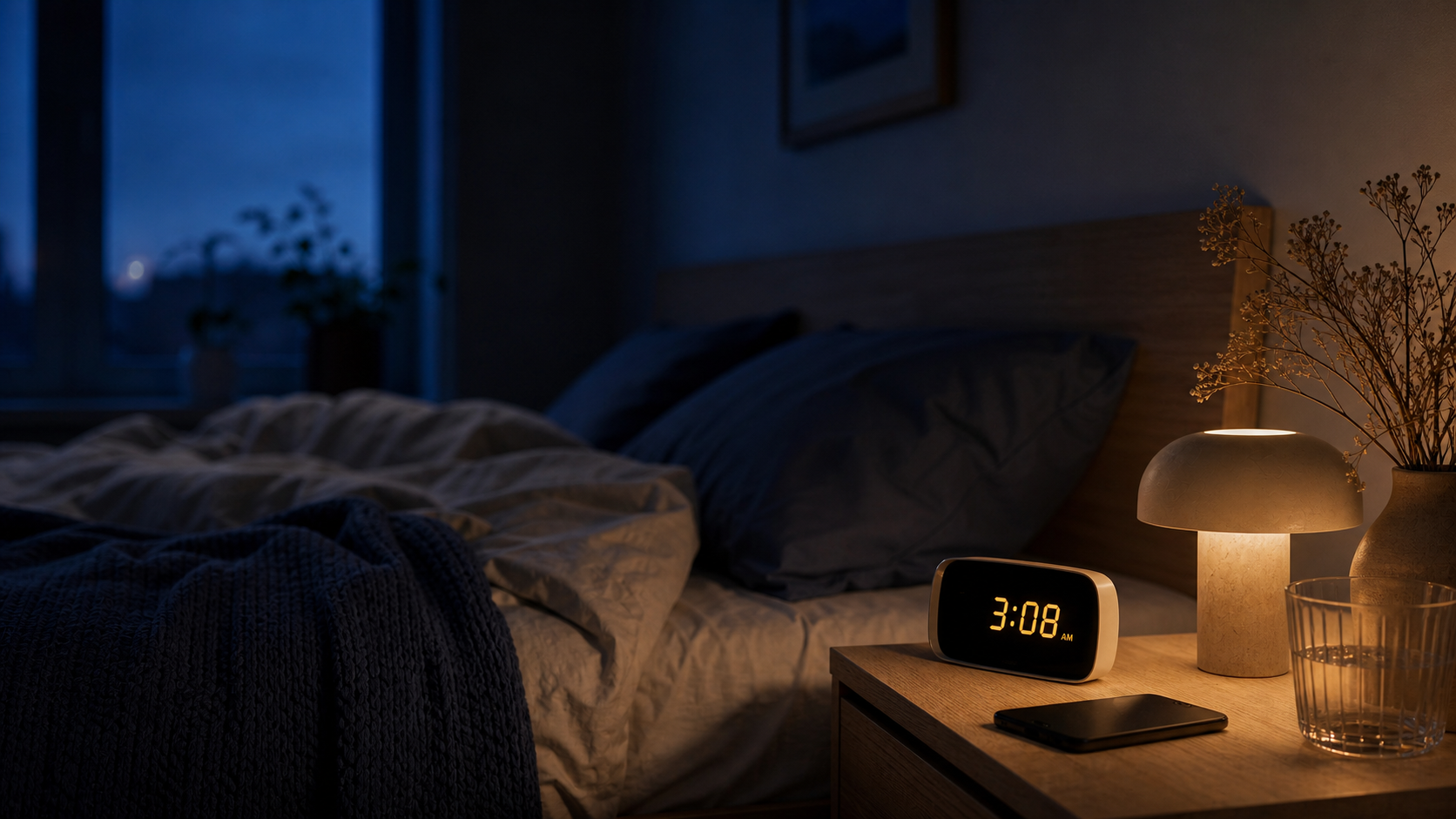
Waking up at 3 a.m. can feel unusually significant. The digits are precise, the room is quiet, and the mind quickly starts asking: Why this time again? What if I do not get back to sleep?
The time itself rarely gives a complete answer. A brief awakening can be part of normal sleep, while a repeated, difficult awakening can be linked to your schedule, surroundings, stress, substances, medication, a health change or a sleep disorder. What matters most is the wider pattern: how often it happens, how long you stay awake and how you function the next day.
First: 3 a.m. is a time, not a diagnosis
Sleep is not one continuous, unchanging state. Adults move through repeated cycles of non-REM and REM sleep, and the US National Heart, Lung, and Blood Institute notes that people may wake briefly between cycles. Later in the night, sleep also contains less deep sleep than it did earlier.
That does not mean every 3 a.m. awakening is “just a sleep cycle.” It means a short transition can become noticeable when something else is present: light through the curtains, a sound, feeling too warm, needing the bathroom, discomfort or an alert train of thought.
Try not to read a universal message into the clock. There is no single organ, hormone or emotional problem that can be identified from “3 a.m.” alone. Look for a pattern rather than a hidden meaning.
Why you may be waking in the middle of the night
Your sleep timing and body clock
Two broad processes help regulate sleep: sleep pressure, which builds while you are awake, and the circadian body clock, which helps time sleep and wakefulness across roughly 24 hours. Light, activity and daily routines help keep that clock aligned.
If bedtime has moved much earlier, your schedule changes between weekdays and weekends, or you work shifts, the sleep period you expect may not match the timing your body is ready to maintain. Sleep timing also tends to move earlier with age, although age alone does not explain every awakening.
A practical bedroom interruption
Noise, unwanted light, temperature and physical discomfort are recognised contributors to poor sleep. Check what actually reaches you at that hour: a heating cycle, outdoor light, a partner’s movement, street noise, pets or pressure from your pillow or bedding.
You do not need to redesign the room. Our guide to a bedroom that supports sleep uses the same one-obstacle-at-a-time approach.
Stress, worry and growing alertness
Stress, anxiety and low mood can make it harder to stay asleep. There can also be a feedback loop: you wake, check the time, predict a ruined day and begin trying hard to force sleep. The bed then becomes a place for monitoring and effort rather than a cue for sleep.
This is not a personal failure. It is one reason cognitive behavioural therapy for insomnia, or CBT-I, works with both sleep-related thoughts and behaviour. If bedtime itself has begun to feel threatening, read when sleep becomes something you fear.
Caffeine, alcohol, nicotine and changing routines
Caffeine and nicotine can interfere with sleep, with sensitivity and timing varying between people. Alcohol may make sleepiness arrive sooner, but it can produce lighter sleep and more waking later in the night. Jet lag, shift work and an irregular schedule can also change when you wake.
Rather than adopting a rigid rule from someone else, record when you use these substances and compare that with your own nights.
Health changes, medicines and other sleep disorders
Night waking can occur alongside long-term pain, menopause or perimenopause symptoms, restless legs, mood problems and other conditions. Some prescription and over-the-counter medicines can affect sleep. Do not stop a medicine on your own; ask a doctor or pharmacist whether the dose or timing could be relevant.
Loud snoring, breathing pauses, gasping or choking during sleep, morning headaches and marked daytime tiredness can point towards sleep apnoea and deserve medical assessment. Waking to urinate repeatedly, night sweats, pain or a strong urge to move the legs are also useful details to bring to a clinician.
What to do when you are awake at 3 a.m.
- Stop measuring the night. Turn the clock face away and leave the phone out of reach if you can do so safely. Calculating the sleep you have “left” usually adds a task at the moment you need less effort.
- Check one practical need. Use the bathroom if needed, adjust a cover, reduce an obvious sound or block intrusive light. Keep the light low and avoid turning the check into a full bedroom project.
- Let rest be enough for now. Release your jaw and shoulders, and allow your breathing to settle without using it as a test you must pass. You cannot command sleep, but you can make wakefulness less activating.
- If you feel alert or frustrated, leave the bed for a while. In stimulus control, a component of CBT-I, the aim is to return when sleepy rather than remain in bed struggling. Choose a safe, dim place and a quiet activity, then go back when drowsiness returns. Do not watch the clock to decide when.
- Do not improvise with sleep aids. Avoid taking an extra dose of a medicine or combining products unless a qualified clinician or pharmacist has told you it is safe.
Getting out of bed is not suitable for everyone. If you have a high risk of falls, reduced mobility or use sedating medication, discuss a safer version of this strategy with a healthcare professional.
A calmer plan for the next one to two weeks
A single night gives very little information. A short record can reveal more without turning sleep into a scorecard. Note approximate bedtime and wake time, remembered awakenings, caffeine or alcohol timing, naps, exercise, relevant symptoms and next-day sleepiness. Estimates are enough; a sleep diary does not need to be exact.
- Anchor the morning. Get up at a reasonably consistent time, including after a poor night, instead of repeatedly moving the schedule to compensate.
- Review timing. Experiment with moving caffeine earlier and avoiding alcohol near bedtime. Notice whether late fluids, meals or demanding work coincide with waking.
- Use light deliberately. Seek ordinary daytime and morning light, and keep the environment subdued when you wake at night. Light is a timing cue, not a switch that guarantees sleep.
- Remove one physical obstacle. If light is the clear issue, explore practical darkness options such as sleep masks. For predictable noise, see sound and quiet options. If pressure or temperature comes from the sleep surface, review pillows and bedding. These products address the environment; they do not treat insomnia or an underlying condition.
- Judge the pattern by daytime impact. Note concentration, mood and sleepiness, not only the number on the clock.
Make one or two changes at a time. A perfect routine is not required, and changing everything at once makes it difficult to learn what mattered.
When night waking may be insomnia
Insomnia can involve difficulty falling asleep, staying asleep or returning to sleep after waking, despite having an adequate opportunity to sleep. The daytime effect is part of the picture. One remembered awakening, or a few difficult nights during a stressful week, does not establish a disorder.
Clinicians may describe insomnia as chronic when symptoms occur at least three nights a week for at least three months and are not fully explained by another problem. That threshold is for assessment, not a reason to wait three months before asking for help.
For ongoing insomnia, general “sleep hygiene” tips may be useful but are not always enough. The American Academy of Sleep Medicine strongly recommends multicomponent CBT-I for adults with chronic insomnia and advises against relying on sleep hygiene as the only treatment.
When to seek professional advice
Arrange an appointment with a doctor or qualified sleep professional if the problem has lasted for months, self-care changes have not helped, or sleep loss is making daily life hard to manage. Seek advice sooner if:
- someone notices breathing pauses, gasping, choking or frequent loud snoring;
- you are very sleepy during the day, especially while driving or doing safety-sensitive work;
- waking is accompanied by pain, night sweats, repeated urination, restless legs or a major mood change;
- the pattern began after starting or changing a medicine;
- menopause or another health change may be contributing.
Do not drive when sleepy. A clinician can review the whole pattern, check for another sleep disorder or health issue, and discuss appropriate treatment rather than guessing from the wake-up time.
This article offers general education for adults and is not a diagnosis or individual medical advice.
Frequently asked questions
Why do I wake up at exactly 3 a.m. every night?
A repeated time can reflect a stable bedtime, your body-clock timing, a recurring environmental cue or the moment you tend to notice and remember being awake. The time alone cannot identify the cause. A one- to two-week diary is more useful than interpreting one clock reading.
Does waking at 3 a.m. mean my cortisol is too high?
Cortisol follows a daily rhythm and normally helps prepare the body for waking towards morning. An awakening at one particular time does not prove a cortisol disorder or tell you that a hormone test is needed. Discuss broader symptoms with a clinician rather than self-diagnosing from the clock.
Should I stay in bed if I cannot fall back asleep?
If you remain drowsy and calm, there is no need to rush out of bed. If you become alert, frustrated or start struggling, stimulus-control guidance supports getting up for a quiet, low-light activity and returning when sleepy. Adapt this advice if getting up at night could be unsafe.
Is waking during the night normal?
Brief awakenings can happen between sleep cycles, and you may not remember most of them. Repeated long awakenings, early waking that prevents enough sleep, or significant daytime effects deserve more attention.
Can a sleep mask or white noise stop 3 a.m. waking?
They may reduce a specific trigger such as early light or intermittent noise. They cannot diagnose the reason for waking and should not be presented as treatment for insomnia, sleep apnoea, menopause symptoms, pain or anxiety.
A quieter way to read the clock
Waking at 3 a.m. does not automatically mean something is wrong, and it does not carry one universal explanation. Start with the pattern, reduce one obvious obstacle, keep the morning steady and notice how you function during the day. If the awakenings persist or affect safety and daily life, professional assessment is the more useful next step.
Sources
- NHS: Insomnia
- National Heart, Lung, and Blood Institute: Sleep phases and stages
- National Heart, Lung, and Blood Institute: Body clock and sleep pressure
- National Heart, Lung, and Blood Institute: Insomnia diagnosis and sleep diary
- National Heart, Lung, and Blood Institute: Insomnia treatment and sleep habits
- American Academy of Sleep Medicine: Behavioral and psychological treatments for chronic insomnia
- NHS: Sleep apnoea
- NHS: Menopause and perimenopause symptoms

Share:
A Sleep-Friendly Bedroom: Calm Changes That Matter